Hey all. 2nd-year scout dad here. I won our troop's outlaw division last year, so now I have to make sure I improve on last year's design. I've been thinking about friction points and how to minimize them, and had a thought about the contact point against the rail. I tried to research it, but I haven't been able to find anything. This means that either 1) it's a stupid idea, 2) it's against the rules, 3) my Google-fu isn't up to snuff, or 4) (and most unlikely) it's a novel idea and I'm a genius.
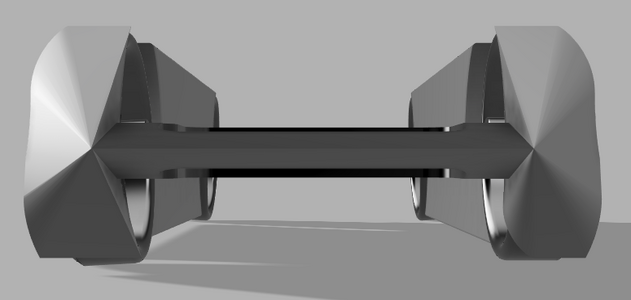
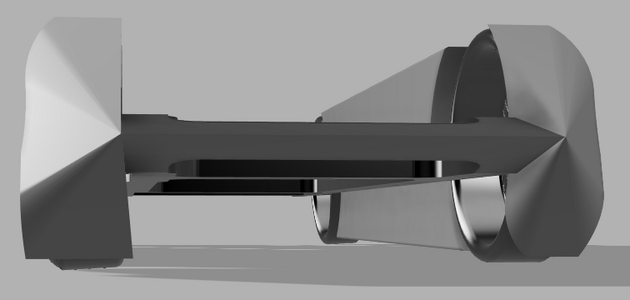
So, on a normal rail rider, the dominant wheel steers into the rail, where it rubs against the rail due to both the car's forward movement and the wheel's own rotation. Although the inner tread is highly polished, it's still (I presume) a significant source of energy loss. But what if part of the car's body contacted the rail instead? I was thinking about extending the front dominant-side fender at an angle below the body, with as small a contact point as possible. I could put a piece of (polished?) PTFE tape on that area, as from what I've seen PTFE has a lower coefficient of friction than the polystyrene that the BSA wheels are made of. I've attached a couple of CAD renders of what I'm thinking.
Thoughts? Has it been tried? Debunked? Am I overlooking something or making incorrect assumptions about things? I'd love to hear critiques! I know that despite my ridiculous amounts of research, I'm still very new to all of this. Thanks!
So, on a normal rail rider, the dominant wheel steers into the rail, where it rubs against the rail due to both the car's forward movement and the wheel's own rotation. Although the inner tread is highly polished, it's still (I presume) a significant source of energy loss. But what if part of the car's body contacted the rail instead? I was thinking about extending the front dominant-side fender at an angle below the body, with as small a contact point as possible. I could put a piece of (polished?) PTFE tape on that area, as from what I've seen PTFE has a lower coefficient of friction than the polystyrene that the BSA wheels are made of. I've attached a couple of CAD renders of what I'm thinking.
Thoughts? Has it been tried? Debunked? Am I overlooking something or making incorrect assumptions about things? I'd love to hear critiques! I know that despite my ridiculous amounts of research, I'm still very new to all of this. Thanks!